
Technology Breakthroughs
How energy storage became cheap
Battery prices fell more than 75% in a decade. The tax credit market is taking notice.
Published in Footnote Issue 1 · July 2026 pp. 22-23

Grid-scale battery storage has gone from expensive to cheap in a decade, and that quietly changes what the grid can do with renewables.
In addition to their use in various consumer technologies like cell phones, laptops, and electric vehicles, lithium-ion battery cells are the backbone for a majority of grid-scale storage projects. In 2015, lithium-ion cells cost $332 per kilowatt-hour. By 2024, they had fallen to $78, more than a 75% decline over the past decade — dropping faster than any other prevailing clean energy technology over the same period.
Forces have converged to put downward pressure on battery costs. The cost decline can broadly be explained by manufacturing scale. Every doubling of cumulative lithium-ion cell production has historically knocked roughly 20% off unit cost, and the industry has doubled many times over. Within the scale story, a driving factor is improvements in chemistry. A lithium-ion cell today can pack far more energy into the same container than a decade ago, at a fraction of the cost.
Lithium iron phosphate (LFP), a type of lithium-ion battery that was once a niche chemistry, has matured into the default for utility-scale storage. LFP boasts cheaper raw materials than the legacy nickel-and-cobalt mix, better thermal safety, and longer cycle life. Energy density has also improved substantially from where it stood a decade ago.
Price of lithium-ion battery cells
Representative estimate of the price of battery cells for lithium-ion batteries, across all major cell chemistries. Prices are in US dollars per kilowatt-hour, adjusted for inflation.
| Category | Value |
|---|---|
| 2014 | $434 |
| 2015 | $332 |
| 2016 | $259 |
| 2017 | $185 |
| 2018 | $156 |
| 2019 | $130 |
| 2020 | $122 |
| 2021 | $117 |
| 2022 | $130 |
| 2023 | $109 |
| 2024 | $78 |
Data source: Rupert Way (2026) based on Ziegler and Trancik (2021), BloombergNEF, and Avicenne Energy. Note: This data is expressed in constant 2024 US$ per kilowatt-hour. OurWorldinData.org/energy
Values not printed on the original chart were reconstructed from the print file's vector geometry and checked against the figures stated in the text.
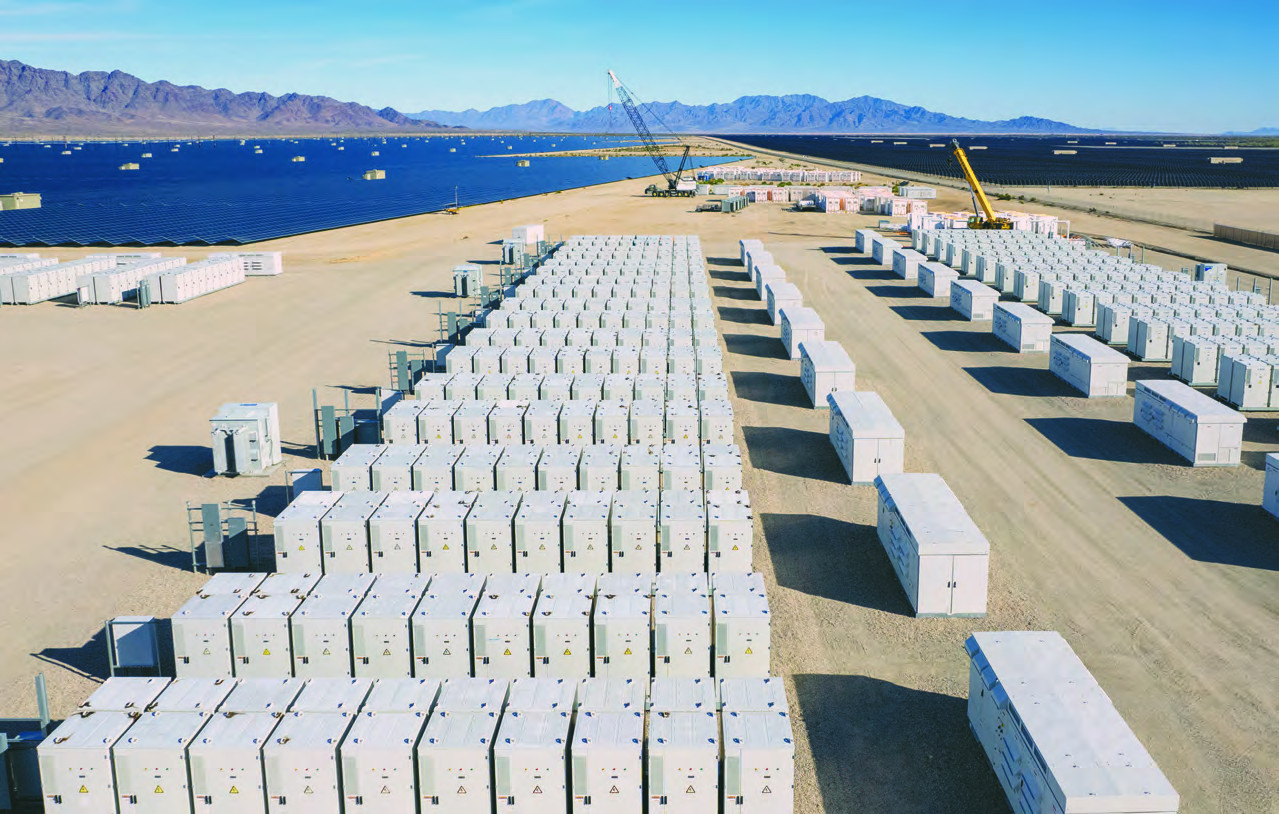
A growing number of utility-scale storage projects can provide well over 100 megawatts of instantaneous power delivery and 400 megawatt-hours of total storage — enough electricity to back up around 14,000 U.S. homes for a day. Significantly larger projects are popping up.
The storage development pipeline dwarfs anything that was imaginable in 2015. Behind that pipeline is a structural shift: batteries have become essential infrastructure for grid operators managing variable renewable sources, creating scale that accelerates cost reductions.
U.S. battery storage capacity has grown exponentially over the past five years
Cumulative U.S. utility-scale battery power capacity (2011-2025)
Gigawatts (GW)
| Category | Gigawatts (GW) |
|---|---|
| 2011 | 0.04 |
| 2012 | 0.1 |
| 2013 | 0.1 |
| 2014 | 0.1 |
| 2015 | 0.2 |
| 2016 | 0.4 |
| 2017 | 0.5 |
| 2018 | 0.7 |
| 2019 | 0.9 |
| 2020 | 1.5 |
| 2021 | 4.7 |
| 2022 | 9 |
| 2023 | 16.1 |
| 2024 | 27.2 |
| 2025 | 43.5 |
Data source: U.S. Energy Information Administration, Preliminary Monthly Electric Generator Inventory, April 2026
Where tax credits fit into the story
Before the Inflation Reduction Act (IRA), standalone storage was not eligible for the Investment Tax Credit. To qualify, a battery system had to be paired with and charged primarily (at least 75%) from a new renewable generator like solar or wind during each of the first five years of operation. The IRA changed that. Under the IRA, the installation of a battery system can qualify for tax credits without a new renewable generation source. Additionally, the IRA additionally created a new tax credit to support the production of eligible battery hardware.
The Clean Electricity Investment Tax Credit — under Internal Revenue Code (IRC) §48E — is the primary credit for standalone utility-scale storage which began construction on or after January 1, 2025. It is technology-neutral and the qualification criteria for energy storage facilities is quite broad. Similar to other credits, the base rate is 6% of eligible project costs, scaling to 30% with prevailing wage and apprenticeship (PWA) compliance. Domestic content and energy community bonus adders can push the effective rate above 50%.
IRC §45X, the Advanced Manufacturing Production Credit, is also highly relevant for energy storage projects, but sits one step upstream. It rewards domestic battery production at rates ranging from $10 to $45 per kWh depending on component type, plus 10% of production costs for electrode active materials and relevant critical minerals. Manufacturers, not project developers, generate §45X credits. As more U.S. cell and module capacity comes online, §45X credits are showing up more often in the transfer market.
What to watch
An important area to watch in the coming years is the battery supply chain. American battery manufacturing is scaling, but the unit economics are tighter. Most lithium-ion cells are still made in China, which puts the IRA's Foreign Entity of Concern (FEOC) restrictions in the path of most battery storage projects looking to qualify for federal tax credits in 2026 and beyond, as the One Big Beautiful Bill Act expanded FEOC restrictions.
On the technology front, most operating battery storage assets today discharge at maximum power over a 2-4 hour window. Longer-duration storage (8 hours, 12 hours, and even longer), enabled by chemistries like vanadium flow and iron-air, is in early commercial deployment. Cost curves there have not yet bent like we've seen with lithium ion batteries. If they do, the next chapter of large-scale energy storage could be measured in days, not just hours.